How to Display a Sculpture on a Plinth: Height, Proportion and Placement
15 November 2026 · Husain Vajihi, founder of 1-OPH
Short answer: Set a plinth so the most important part of the sculpture sits near eye level, around 140 to 160 cm from the floor for a standing viewer. Make the top a little larger than the sculpture's footprint, choose a stone or finish that contrasts with the piece, and always fix the two together.
A good sculpture on the wrong plinth looks like a good painting in a cheap frame. I see it constantly: a beautiful bronze sitting on a side table that is too low, or a small marble piece perched on a column so tall it looks like it is trying to escape.
The plinth is half the presentation. Here is how we decide height, width, material and position before anything leaves our hands.
How tall should a sculpture plinth be?

Work backwards from the eye. For most pieces, the part you want people to look at, a face, the top of a curve, the opening in a form, should sit around 140 to 160 cm from the floor, which is roughly where a standing adult's eye falls. So a 40 cm piece wants a plinth of about 100 to 115 cm. A 70 cm piece wants something closer to 80 or 90 cm.
There are exceptions. Pieces meant to be looked down into, like a bowl form or a low abstract with a hollow, often sit better lower, around 70 to 90 cm. In a majlis or a room where people sit, drop everything by 10 to 20 cm, because the eye is lower. A tall standing figure usually wants a low base, or none at all, so it meets you at its natural height.
How wide should the plinth be compared with the sculpture?

The top should be slightly larger than the sculpture's footprint, usually a few centimetres of margin on every side. Too tight and the piece looks like it is about to fall off. Too wide and the plinth starts to look like furniture with something left on it.
For tall, slim plinths, check the proportion from across the room, not up close. A column that is very thin relative to its height can look nervous, especially under a heavy bronze. If in doubt, go slightly wider and slightly shorter. A plinth with a stepped or chamfered base, like the ones in our plinths and bases collection, gives you a wider footprint without making the top look heavy.
Which material should the plinth be?

Contrast is your friend. A pale marble piece looks strongest on a dark base: black marble, dark granite or a bronze-toned steel. A dark bronze looks strongest on travertine, white marble or a pale stone. Mirror steel on black is dramatic; mirror steel on travertine is softer and warmer.
Texture matters as much as colour. A polished sculpture on a honed plinth reads clearly, because the light behaves differently on each. Two polished surfaces stacked together can look busy. Our travertine guide covers why that stone has become the default base for metal pieces, and the honed vs polished marble guide explains the finishes.
How should a plinth be lit at night?

Light the sculpture, not the plinth. An angled spot from the ceiling, set so the light falls on the piece and spills softly down the plinth, is usually enough. If the plinth has strong veining, like a gold-veined Calacatta, a little of that spill makes the stone glow without stealing attention.
We never build lights into plinths or into the pieces themselves. Light from outside keeps the stone looking like stone and the metal looking like metal. The angles and colour temperature we use are in how to light a sculpture at home.
How do you fix a sculpture to a plinth safely?

Always fix them together. We anchor the sculpture to the plinth so it cannot slide or be knocked off. For tall plinths in homes with children, pets or busy staff, we also fix the plinth to the floor or the wall behind it.
Weight is the other check. A solid marble plinth can weigh more than the sculpture on it. On upper floors and in apartments, we confirm the floor can take the combined load before delivery. Hollow or clad plinths are an option where weight is a concern.
Where in the room should a plinth go?

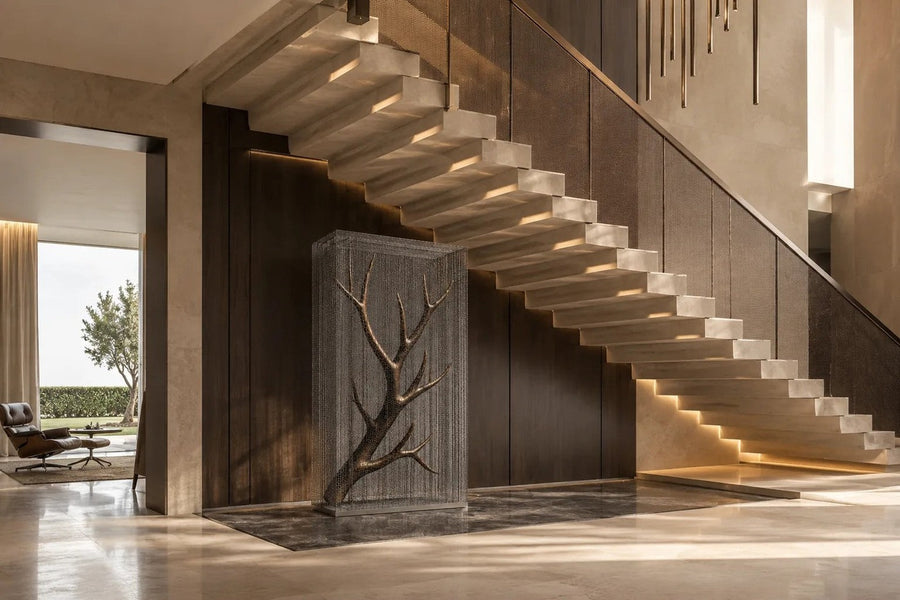
Somewhere people stop, with space to walk around it if the piece is meant to be seen in the round. A plinth at the end of a corridor, in the centre of a stair landing, or in the corner of a living room where two sightlines meet all work well. A plinth crammed against a wall wastes a three-dimensional piece.
Leave clear floor around it, at least the width of the plinth again on each side. The room-by-room logic is in where to place a sculpture in your villa, and grouping several pieces on plinths is covered in placing a collection in one home.
What I tell clients
- Put the important part of the piece near eye level, around 140 to 160 cm.
- Make the plinth top slightly bigger than the sculpture's footprint, not much bigger.
- Choose a plinth that contrasts with the piece in colour or finish.
- Anchor the sculpture to the plinth, and fix tall plinths to the floor or wall.
- Give a plinth room to be walked around.
Frequently asked questions
How tall should a plinth be for a sculpture?
Tall enough that the main part of the piece sits around 140 to 160 cm from the floor for standing viewers. Lower for bowl-like forms or rooms where people sit.
How wide should a sculpture plinth be?
A little larger than the sculpture's footprint, with a few centimetres of margin on each side. Much wider and it starts to look like furniture.
What colour plinth suits a white marble sculpture?
A dark base such as black marble, dark granite or a bronze-toned finish gives the strongest contrast.
Should a sculpture be fixed to its plinth?
Yes. It should be anchored to the plinth so it cannot slide, and tall plinths should be fixed to the floor or wall in busy homes.
Can a plinth be lit from inside?
We don't recommend it. Light the sculpture from outside with an angled spot and let the light fall softly onto the plinth.
Have a piece that needs the right base? Send us its size and a photo through the customise page, or browse plinths and bases.
1-OPH designs and delivers bespoke sculpture, water features, fireplaces, benches and planters in marble, stainless steel and bronze, for homes, hotels and developments across the UAE and GCC. Showroom in Al Quoz, Dubai.