
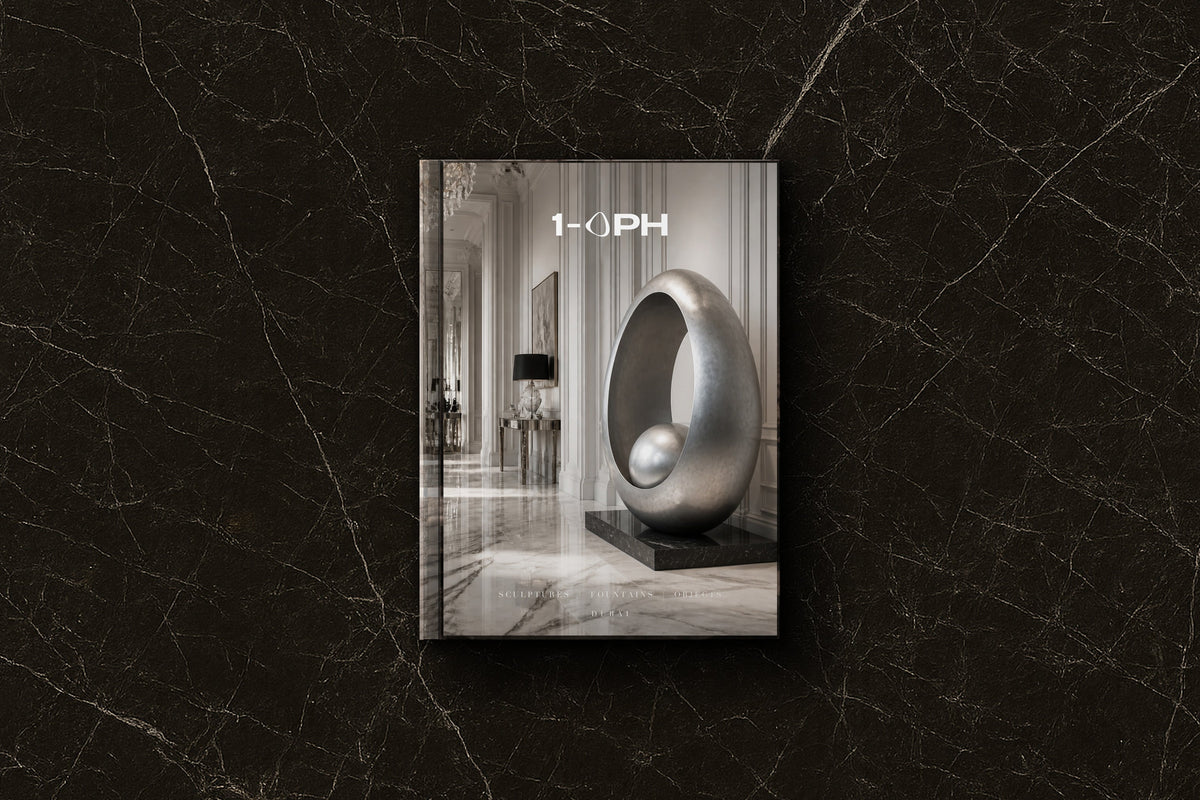
In hospitality, a sculpture is not only art — it works for the brand. A well-placed piece in a lobby, restaurant or suite shapes the guest's first impression, gives a property an identity, and becomes the image guests photograph and remember. Placement in these spaces answers a different question from the home: not just where a piece looks best, but where it does the most for arrival, flow and memory, while surviving a public, high-traffic setting. This guide covers placing sculpture across hospitality spaces — the arrival moment, the public rooms, the guest journey, and the practical demands of the setting.

The arrival moment

The lobby is where a property makes its first and strongest impression, and a sculpture is one of the most effective ways to make it. A landmark piece at arrival sets the register of the whole property before a guest reaches the desk.
Placement follows the guest's eye on entry. The strongest position is usually the natural focal point of the arrival sequence — terminating the view from the entrance, anchoring a central atrium, or marking the transition into the property. The piece should be read from the door and rewarded up close.
Scale matters more here than almost anywhere. Hospitality lobbies are large, and a piece must be bold enough to hold the volume and the traffic — a modest work is swallowed. In the region's landmark properties on the Palm, Saadiyat and the Red Sea developments, arrival pieces are scaled to command.
The public rooms

Restaurants, bars and lounges use sculpture to give each space its own identity within the property. A piece here is placed to be experienced from the table — read across the room, forming the backdrop to the guest's time in the space.
Flow is the discipline. In spaces people move through and sit within, a piece must not obstruct circulation or service, and is positioned where it is seen but not in the way. Sightlines from the key seating areas guide the placement.
Sculpture also zones. In a large open hospitality space, a well-placed piece can mark a transition, anchor a lounge area, or give a restaurant a centre — doing spatial work as well as aesthetic.
The guest journey and repeat moments

Beyond the headline spaces, sculpture punctuates the guest journey — a piece glimpsed along a corridor, marking a lift lobby, or anchoring a garden or pool terrace. These repeat moments build the property's identity as the guest moves through it.
In suites and premium rooms, a smaller considered piece signals quality and care at the most personal scale, and is placed where the guest lives with it — read from the bed, the desk, the seating.
A coherent programme of pieces across these moments, sharing a material and design language, makes a property feel curated by one hand — the same discipline that governs a private collection, applied at the scale of a hotel.
The practical demands of the setting


Hospitality is a hard environment, and pieces are specified for it. Public, high-traffic settings demand durable materials and finishes — Grade 316 stainless and bronze outdoors and near water, hard-wearing stone finishes, and surfaces that resist marks and simplify cleaning.
Safety and robustness are engineered in: pieces in public circulation are anchored, stable and free of hazards, and positioned clear of service routes and heavy traffic.
Maintenance is planned from the start and handed to the property's facilities team, so the programme holds its quality through years of use. A hospitality piece must survive being lived with by thousands, not one, and the specification reflects that from the outset.
FREQUENTLY ASKED QUESTIONS
Where should sculpture go in a hotel?
At the arrival moment above all — a landmark piece in the lobby that sets the register of the property. Beyond that, in public rooms placed for the seated view, along the guest journey as repeat moments, and in suites at a personal scale.
How is hospitality art placement different from a home?
It answers a different question: not just where a piece looks best, but where it does the most for arrival, flow and memory while surviving a public, high-traffic setting. Scale, circulation and durability all weigh more heavily.
What scale should a hotel lobby sculpture be?
Bold enough to hold the volume and the traffic. Hospitality lobbies are large, and a modest piece is swallowed. In landmark Gulf properties, arrival pieces are scaled to command the space and be read from the entrance.
How are pieces made durable for hospitality use?
Through specification for a hard, public environment: Grade 316 stainless and bronze outdoors and near water, hard-wearing stone finishes, mark-resistant surfaces, engineered anchoring and safety, and maintenance planned and handed to the facilities team.
Can sculpture help zone a large hospitality space?
Yes. A well-placed piece can mark a transition, anchor a lounge, or give a restaurant a centre, doing spatial work as well as aesthetic — while positioned to avoid obstructing circulation or service.
1-OPH is an art atelier based in Al Quoz, Dubai. We design and fabricate bespoke sculpture, water features, and architectural art in marble, stainless steel, bronze, and mixed materials — for private residences, hospitality projects, and developments across the UAE and GCC.

Share:
The Return of the Monumental: Scale in Contemporary Sculpture
Mixed-Material Sculpture: Combining Marble, Bronze and Steel